|
Avani Avittam
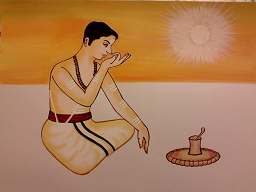
Upakarma (Beginning) also called Avaṇi Aviṭṭam is a Vedic ritual practiced by Brahmin, Kshatriya and Vaishya community. Avani is the Tamil month and Avittam is one of the 27 nakshatras (stars). Avani Avittam is of great significance in Kerala, Tamil Nadu and other southern states. The day is of great significance to Rig, Yajur, Sama and Atharva Vedic Brahmins. On the next day, Gayatri Japa Sankalpam is observed. Hindus change the new holy thread known as ‘Yagnopavitam’ and offer libations of water to the ancient Rishis on this day. The day is auspicious because as per Indian mythology Vishnu was incarnated as Hayagriva, the God of knowledge, and the one who restored the Vedas to Brahma.
The followers of the four different Vedas have their Upakarma on different days.
- Rigveda Upakarma: People celebrate on the day in Shraavana where Shravan is the star and spans at least from sunrise to mid-day.
- Samaveda Upakarma: People celebrate on Hasta nakshatra on Bhadrapada Sukla paksha.
- Krishna Yajurveda: People celebrate on Avittam (Dhanishta) nakshatra in the Tamil month Avani in Krishna Paksha.
- Sukla Yajurveda: People celebrate on Purnima tithi in Sukla Paksha in Tamil month Avani. We should never consider the day when Prathama is beginning and Purnima is ending on the same day. But if Uttarashada nakshatra is there till night then it is ok even if Prathama tithi is there.
- Atharva Veda: People celebrate on the day when Purnima lasts during sunrise.
Legend
The significance of this day is that Lord Vishnu took the form of a horse and restored the Veda that was stolen from Lord Brahma by the demons Madhu and Kaitabha. As lord Vishnu took the form of a horse, this incarnation is called Hayagriva (horse-head). After Lord Vishnu created Lord Brahma, he taught Brahma the all eternal Vedas. Once Lord Brahma had mastered the Vedas, he was filled with pride that he was the only entity that had the knowledge of the holy Vedas. Lord Vishnu wanted to teach Lord Brahma a lesson and created demons Madhu and Kaitabha from two water drops on the lotus that he mounts. He then instructed them to steal the Vedas from Lord Brahma and hide it. Lord Brahma not being able to save the holy and all eternal Vedas, prayed to Lord Vishnu to help him. So Lord Vishnu took the form of Hayagriva and restored the all-pervading Veda to safety thus curbing the pride of Brahma. So the day of Upakarma is also celebrated as Hayagriva utpatti. As the Vedas were restored on this day, Upakarma is performed on this day to mark a new beginning.
Significance of Avani Avittam
On the Avani Avittam day, Brahmins take a holy dip and change the sacred thread and wear a new holy thread. This ritual is known as Upakarma and the sacred thread is referred as Poonool, Yajnopavita or Janeyu. The ritual also symbolizes the permission to study the Vedas. Usually the function is conducted by communities and large number of people participate in the ritual. It is a highly auspicious day for the Brahmin community. It is also a day for traditional Vedic studies. Recitation of the Vedas on this great day is highly beneficial. Being a Brahmin (Brahmana) was not a birth right upper caste in ancient days. Anyone could be a Brahmana if he or she knew the reality (Brahman). The one who knows the Brahman and the one with Brahmagyanam (realization of the Ultimate Truth) is the Brahmana. The married will have two poonool and the unmarried will have one with three threads. In ancient times women also wore such sacred threads and performed Sandhya rites (ritual for the realization of the divinity of the Self).
Spiritual Significance of Avani Avittam
The main purpose of the Upakarma function is to offer prayers and express our gratitude to those Rishis through whom the Vedic mantras were revealed. This day is also auspicious as the Brahmins offer libations of water to their ancestors to whom they owe their birth and to the great Rishis to whom they are highly indebted for spiritual knowledge and the Vedas themselves. When men/boys are bestowed with the Sacred Thread it is said that the third eye (the eye of wisdom) opens on this day. This festival of Upakarma reminds the wearer of the sacred thread of its glorious spiritual significance. A Mahasankalpam or a vow is taken for the expiation of all the sins in the past year. Thread changing process symbolizes the shedding of all sins and making a new beginning. It also involves the renewal of their pledges to keep their Vedic duties towards society and humanity at large. The married will have two poonools (one for his wife). It is the outward and visible mark that the wearer is twice-born. The unmarried will have one with three threads. The composition of the sacred thread has lot of symbolism in it. Its length is ninety-six times as the breadth of the four fingers of a man, which is equal to his height. Each of the four fingers represents the four states of consciousness a man experiences from time to time. They are waking, dreaming, dreamless sleep and absolute Brahmanism (Turiya or the fourth state). There are different versions as to what the three threads represent such as Sat-Chit-Ananda, Satwa-Rajas-Tamas Gunas and Brahma-Vishnu- Maheswara. On the next day, Gayatri Japa Sankalpam is observed. Goddess Gayatri is the mother of the Vedas and the destroyer of sins. She is shown as having five heads and is seated on a lotus. The four heads of Gayathri represents the four Vedas (Rig, Yajur, Saama and Atharvana) and the fifth head represents the almighty. It is believed that by chanting the Gayathri Mantra, we not only receive the blessings of Goddess Gayathri but she also removes our sins and saves the world from calamities. It is also believed that our wisdom and intellect get enlightened to reveal the true nature of the Supreme Lord.
|


